
Subscribe to blog updates via email »
Not finishing what you start is actually pretty smart
This article originally appeared on Maximum Reverie »
The man who published 500 left 150 unfinished – and that’s just the beginning. His unique paper trail provides clues on how creative works get done (or don’t).
WANT TO WRITE A BOOK?
Download your FREE copy of How to Write a Book »
(for a limited time)
When Niklas Luhmann1 began his professorship at the University of Bielefeld, he stated an ambitious plan: “My project: theory of society. Time to complete: thirty years.”
He went on to publish a 1,200-page magnum opus. Its topic: theory of society. Time to publish: thirty years.
That’s the kind of planning and foresight we imagine having when we take on creative projects. You begin dreaming about a seven-book epic fantasy series, or a chain of innovative learning centers strewn about the country. But somewhere around 10,000 words or page seven of the business plan, something happens.
It looks like you just lose motivation, higher priorities get in the way, or life throws you a curveball. But what if it’s something simpler than all that?
What if you don’t finish what you start because it makes perfect sense?
Luhmann’s book, Theory of Society, covers in great detail every aspect of society, from law to commerce, from politics to love. On the surface, it’s incredible someone could state such an ambitious plan that spanned decades, then carry it out perfectly. But when we look closer it seems almost like what Bob Ross would have called “a happy accident.”
More than a quarter century after Luhmann’s death, his writing and research process is still itself the subject of ongoing research. Most famously, Luhmann left behind a couple cabinets2 full of 90,000 paper notes.
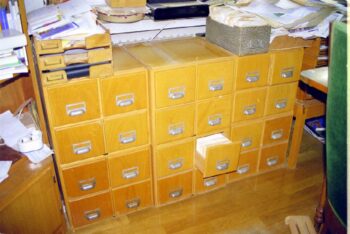
The University of Bielefeld has been digitizing these notes, aiming to publish all of them online. You can browse through each, but as you can see from the sample below3, you better understand German. Not to mention Luhmann’s handwriting looks like a car designed by members of the Vienna Secession, wrapped around a light pole.
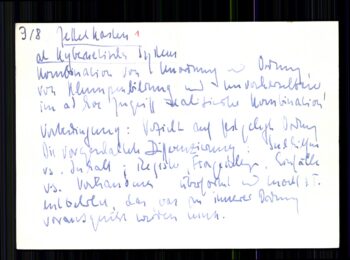
Lucky for us, the lead researcher on the project, Johannes F.K. Schmidt, has examined these notes and published a series of papers. What he’s found shows us Luhmann’s life’s work was anything but perfectly planned.
500 publications (that’s just what he got around to)
If you are or have attempted to be a writer, designer, entrepreneur or other creative, you know finishing what you start rarely goes as planned. Somehow Luhmann was able to make that part of the plan.
Maybe this sounds familiar: You get an idea for a project, then a burst of energy. At some point – whether it’s thirty minutes, three hours, or three weeks – something gets in the way. The project lingers in the back of your mind as you address more pressing matters. It unofficially becomes another rusted chassis in the boneyard, forgotten until the next Big Idea.
That’s when it resurfaces as a reminder: Why bother? It will just turn out like the last one.
Luhmann didn’t state a thirty-year project goal then disappear into a cave to carry it out. His magnum opus was just one work of many. In fact, he published 500 times: something like seventy books and over 400 articles.
Perhaps less intimidating and more comforting: He also left behind 150 unfinished works.
Schmidt and his colleagues are able to learn about Luhmann’s creative process because of the unique way he organized his notes. They weren’t sorted top-down, like the folders on your hard drive. Instead, Luhmann arranged the notes in what he himself described as like a “web” – decades before the World Wide Web.
Exactly how he organized his notes is more germane to the cultish followers of his method, known by the German word, Zettelkasten – a pretentious-sounding way of saying, Paper in a box. Suffice to say he branched his notes by codes compiled of alternating numbers and letters, created links amongst notes, and kept a directory of hundreds of keywords covered by the notes.
Within the limitations of physical paper, Luhmann did whatever he could to develop a system with no hierarchy. He described it as a system with “a combination of disorder and order.” From any one note, he could follow links and keywords to any other note in the system. He basically made his own paper Wikipedia, starting in the 1960s.
Because each note has its place, along with subtle clues like how worn a given note is and what’s on the back side of the scrap paper it was written on, researchers have a pretty good idea what Luhmann’s process looked like.
This helps us see how smaller works transformed into bigger works, and bigger works into smaller works. For example, he would stack notes together to write a presentation, and in the process of writing the presentation put additional notes back into his collection. Then he would expand the presentation into a book.
His system also gives us some sense, beyond the 150 unfinished works he left behind, just how many dead-ends and unexpected detours make up a creative career.
As Luhmann said:
“There are sets of ideas that were anticipated to become major complexes and are never elaborated; and there are secondary ideas that came to mind that gradually become more enriched and inflated.” —Niklas Luhmann
Stating a thirty-year project plan up-front then actually carrying it out seems superhuman. The actual story is more relatable. Even in the process of publishing 500 works that built up to his magnum opus, Luhmann in some sense started countless projects he never finished.
By the time he began his professorship in 1969, Luhmann had been compiling notes as he read for decades. He had experimented with methods such as keeping notes within the books he was reading or organizing them into folders before finally settling on his Zettelkasten method.
In 1969, he had been compiling his current collection for seven years. Before starting that collection, he had kept another collection for a decade. He apparently had to start over because he wasn’t satisfied with how the first collection was organized.
When he had started his second collection, his goal hadn’t been to form a theory of society, but an entire other book on administrative theory – which he never wrote. Researchers can see from his collection that his notes on a theory of society were filed deep within the system.
The lesson is useful to any creative who has struggled to finish what they start: What seemed would become his major focus turned out to be nothing. What had been a minor interest grew to define his career.
Not finishing is a part of finishing
When you take on a new project, there’s so much you don’t know. You haven’t built your fantasy world and your new teaching method hasn’t been proven. That you run out of motivation or other things take priority shouldn’t be a surprise. You don’t actually have information that confirms you’re on the right track or that the struggle will be worth it.
As Luhmann’s process shows us, grand visions are rarely carried out from plan to execution. They more often emerge from an improvisational process consisting of a combination of many projects – from tiny notes, to small articles, to big books, to grand theories. Many don’t become anything at all.
So instead of letting those rusted chassis in the boneyard discourage us from trying again, we should accept them as part of the process, and keep in mind Luhmann’s explanation for why he started organizing his work around tiny works that either fizzled out or blazed new trails: “It was obvious to me that I would have to plan for a lifetime not for a book.”
This article originally appeared on Maximum Reverie »
Footnotes

.png)