
SUMARY: Mind Management, Not Time Management
This is a summary of Mind Management, Not Time Management, a framework for doing creative work by managing your mental states instead of your time.
I’m the author of the book, so this overview comes from personal experience!
If you prefer video, I’ve also posted a summary on YouTube.
“Mind management” is the practice of aligning your mental states, creative energy, and natural cycles with the type of work you’re doing – instead of trying to optimize time.
In my book, mind management consists of:
- The creative sweet spot (when ideas happen best)
- The four stages of creativity (how ideas form)
- The seven mental states (how work gets done)
- Creative cycles (when to do what)
- Creative systems (how to repeat output)
I’ll expand upon each of those, but first…
Why time management fails for creative work
Time management comes from the industrial age.
Frederick Taylor developed scientific management by optimizing factory workers. He stood next to them with a stopwatch and timed and programmed each movement, so they could stack bricks or move materials faster. This worked for repetitive, procedural tasks.
But creative work is different.
Creative work depends on:
- insight
- exploration
- mental energy
Not just efficiency.
When you over-schedule your time:
- you eliminate space for ideas
- you increase anxiety
- you reduce idea quality
- you reduce creative output
And as AI automates more procedural work, this problem becomes more important.
The bottleneck is no longer time. The bottleneck is our minds.
What is a creative sweet spot?
Your creative sweet spot is the time of day when you are in the best state for idea generation.
Counterintuitively, this is often when you feel less in-control.
You have an insight or an “aha” moment when ideas from disparate regions of your brain collide. Think of your brain as like a racquetball court, with balls bouncing all over it. When two or more collide, that’s like a moment of insight.
Your prefrontal cortex, which is responsible for planning and urge suppression, is like a player that wants every ball to follow the “rules” and hit the front wall first. So it gets in the way of having insights.
So in the morning, when you’re still groggy is often a great time for having ideas.
What are the four stages of creativity?
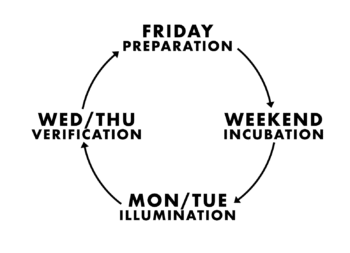
The four stages of creativity are Preparation, Incubation, Illumination, and Verification.
In simple terms: learn, step away, get ideas, then evaluate them.
- Preparation: Turning the problem over in your mind’s eye, so you know it from every angle.
- Incubation: Resting and letting what you’ve learned seep in.
- Illumination: This is the “aha” moment of insight.
- Verification: Reviewing the idea to make sure it meets your requirements.
We tend to get creatively blocked because we try to skip stages. We try to go straight to Illumination, without first going through Preparation and Incubation. We also pass judgement on our ideas too soon, letting what would be the Verification stage get in the way.
What are the seven mental states of creativity?
We tend to think of creative work as one type of thinking. For example, Cal Newport might call it “Deep work.”
But it’s actually several distinct mental states.
The seven mental states I’ve identified are:
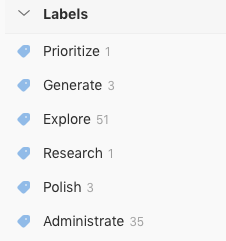
- Prioritize: deciding what matters
- Explore: following curiosity
- Research: answering specific questions
- Generate: producing usable output
- Polish: refining output
- Administrate: handling logistics
- Recharge: restoring energy
Each state uses your brain differently.
For example:
- Explore requires loose, associative thinking
- Polish requires focused, critical thinking
Switching between them is costly.
That’s why editing while writing feels so hard. As in that apocryphal Hemingway quote:
Write drunk, edit sober. —Hemingway (not really)
In simple terms:
- Creative work becomes easier when you match the task to your mental state.
What are creative cycles?
Your energy and thinking ability follow predictable cycles:
- daily
- weekly
- seasonal
Most people try to follow the same routine every day.
But creative output improves when you structure your time across a week, not just a day.
For example:
- Early week > Generate and Explore
- Midweek > Polish and refine
- Late week > Administrate
- Weekend > Incubate and Recharge
This aligns your work with natural fluctuations in energy.
In simple terms:
- Don’t just manage your day. Design your week.
What are creative systems?
Creative systems are repeatable processes that produce consistent output without requiring constant decision-making.
Creative systems let you:
- reuse structure
- reduce friction
- maintain momentum
Example system:
- capture ideas daily
- store them in one place
- revisit and expand the best ones
- publish on a consistent schedule
This turns creativity from a random event into a reliable process.
(I use a creative system to produce my weekly newsletter.)
In simple terms:
- Systems make creativity repeatable.
But, systems have to stand up to real life, so you might wonder…
How do you stay creative amidst chaos?
No system survives contact with real life.
Unexpected events will disrupt your plans.
When that happens:
- rigid systems break
- flexible systems adapt
One of the most effective strategies is to organize tasks by mental state, not by project.
That way:
- when energy is low > do lighter tasks
- when energy is high > do deeper work
You maintain momentum instead of stopping completely.
In simple terms:
- Consistency comes from flexibility, not rigid control.
Mind Management Framework (Summary)
- Time management fails for creative work
- Creativity depends on mental state, not time blocks
- Ideas emerge through four stages
- Work happens across seven mental states
- Energy follows predictable cycles
- Systems turn creativity into output
- Flexibility sustains progress during chaos
Start reading Mind Management, Not Time Management
If you enjoyed this summary and would like to know more, you can start reading Mind Management, Not Time Management here.