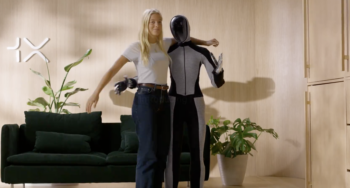
Every time we make a thing easier, we lose some crucial element that was wrapped up within it.
I remember many mornings in San Francisco being struck by irony on my way to work. As I passed the open windows of a gym, I heard pumping music and the amplified shouts of a spinning instructor. The students were riding bikes, exercising while going nowhere. I was riding my bike, exercising while going somewhere.
As AI and robotics advance, we will stop having to do some things. At the same time, we’ll stop doing some things that are good for us.
I’m finding that with these developing powers I now opt for many things I would have once considered drudgery.
I’m growing food, making soap, cooking new recipes, and doing plumbing.
Now that the informational bottlenecks that prevented me from doing these before have been widened, doing more things in the physical world has changed my perspective on other chores, such as laundry, washing dishes, and cleaning.
So when I see a video of a housekeeper android, my immediate reaction is, Damn, I want one of those!
But then I realize that in some version of the future, it’s not the physical drudgery of keeping a household running that we outsource.
The other day, my water distiller broke. The old me would have just spent $125 to buy a new one. Instead I asked Claude to guide me through troubleshooting.
Instead of sitting in an office chair, clicking a one-click-order button, then sitting in an office chair even more to figure out how to make an extra $125, I went into town.
It was a bad capacitor. I didn’t know what that was but I walked around and asked people because you can’t find many businesses on Google Maps. I found an electronics-repair shop, where they soldered in a new one. Parts and labor: $1.25.
My distiller works like new. I got to move around and use my hands and body, and isn’t that what they’re for? I used my mind, but didn’t have to go through the mental drudgery of learning electrical engineering to know it could be a broken capacitor.
Given the trajectory of the past several decades, we’re biased to believe that automation will next lift us out of physical drudgery, but it’s not done lifting us out of mental drudgery. Maybe it’s actually been heretofore pushing us into it.
Maybe we’re made for moving around and doing things in the physical world and shouldn’t be so eager to outsource it to an android.
Aphorism: “There is no habit you will value so much as that of walking far without fatigue.” —Thomas Jefferson
Book:In This Economy (Amazon) is Kyla Scanlon’s fun introduction to money and markets.
I have done just enough jogging to say that pacing yourself is a lot like mind management.
If you’re a beginner and just keep jogging, your lungs soon start to burn and it sucks and you never want to jog again.
By contrast, if you keep yourself within a comfortable heart-rate range – by walking when it’s high and jogging when it’s low again – jogging actually becomes kind of enjoyable. String together enough days of that and you adapt to where you can just cruise along in that range.
In the days before I learned mind management, I would frequently peg myself out mentally in the same way. I’d end up saying, “I never want to edit a video again. That was too mentally exhausting,” not recognizing that of course it was exhausting because I tried to learn a new thing while also powering through getting the thing done.
If you keep monitoring your heart rate, you stop needing to check what it is. You can just feel in your body whether it’s high or low.
Mind management becomes the same, where you can sense that you’ve just been presented with a task and face a choice. You can power through and probably burn yourself out. You can switch mental states and get off the track you were on. Or, you can set that task aside for a better suited pool of energy and stay in the state you were in.
The challenge is, there’s no quantifiable metric you can monitor. The four stages and the seven mental states give you a vocabulary to guide you. From there, you learn through practice.
Aphorism: “What I was given to study in school I have forgotten; what I decided to read on my own, I still remember.” —Nassim Taleb
I’ve been asking myself an insanely simple question that does a surprisingly good job of protecting my attention.
“What’s over there?”
When I reach for my phone: “What’s over there?”
When I switch to a social app: “What’s over there?”
When I get the urge to open my laptop: “What’s over there?”
There’s an arresting simplicity to What’s over there? It forces me to think for a second. In rare cases, I have an answer, and that helps set my intention to fight against being sucked into the maelstrom.
But most of the time, I have to admit, I don’t have a clue what’s over there. I just went there five minutes ago – do I expect something new? Maybe I should create something instead so there’s actually something worth checking on.
I end up fumbling for an answer, and it makes my misguided urges seem kind of dumb – which is the desired effect.
Give it a shot: What’s over there?
Aphorism: “Simple, clear purpose and principles give rise to complex and intelligent behavior. Complex rules and regulations give rise to simple and stupid behavior.” —Dee Hock
Cool: This quiz can tell U.S. people where they grew up in just 25 dialect questions
Pleasing the algorithm too quickly is a path to mediocrity.
If your ideas gain immediate support, they probably aren’t new. If they gain resistance, you’re still in familiar territory. But when your work is met with crickets, that can actually be a good sign.
One of the best ways to do impactful work is to be the first to see the world in a particular way. That’s how you catch the attention of the proverbial “innovators” and “early adopters.”
The algorithm shows work that most people react to. But if most people are reacting to it, it’s already old news. Go ahead and post an Impressionist painting and enjoy the likes, but you’re 150 years too late for it to mean anything.
Obviously, if your work is ignored that very often does mean something is missing, whether it’s craft, legibility, or cultural significance.
But the litmus test is whether it’s still interesting to you. Are the feelings you’re expressing real? Are you still curious about what you could learn by digging deeper?
Comedian Louis CK said, “Always, the best bits I have in a special, the ones that are like, ‘That just kills every time,’ started with silence.”
I know the pieces I’ve felt the most vulnerable to publish are almost always met with crickets at the start. It’s as if you can hear the collective fear of people who say to themselves, “It feels risky to be the first to ‘like’ this.” But when they catch on (if they do) they’re the ones with the widest reach, eliciting the most sincere reactions.
Humans are pack animals. The innovators and early adopters have to lead the pack. But to reach them, you have to endure being ignored, until you have something interesting.
Aphorism: “Will public resistance prevent the introduction of technological control of human behavior? It certainly would if an attempt were made to introduce such control all at once. But since technological control will be introduced through a long sequence of small advances, there will be no rational and effective public resistance.” —Ted Kaczynski
I don’t know if it’s more remarkable that book sales are down lately, or that they stayed as high as they were for as long as they were.
Tim Ferriss recently reported an 80% decrease in book sales, and cited an industry report that self-help sales were down 26%.
Ferriss thinks people are using AI as a replacement for “prescriptive nonfiction.” I think there’s also an overall cultural malaise around ambition.
But I also see an exciting opportunity in the drop in book sales.
Because it seems obvious that self-help and business books for the past decade or so have been written to be sold, not read.
They’ve been entire books about one compelling idea – mostly summarized by the sticky title – stretched out for 250 pages. The text has been broken up by a subhead every 200 words, and littered with one-sentence paragraphs and one-word sentences. There have been diagrams every other page. Concepts have been broken up into bullet-points, the flow of text interrupted by sidebars, each chapter ending with “key takeaways.”
I personally hate this kind of “book.” I don’t know that I have in the past ten years once finished reading a book in this category, aside from the rare ones absent these features. Subtle Art and Four Thousand Weeks come to mind.
But that is what you get when the book industry responds to a market of readers who don’t actually like to read. James Clear has said he only expects people will read the first fourteen pages, so that’s where he concentrated value in Atomic Habits.
I like to read books. I enjoy prose. I do not enjoy sifting through a stew of bite-sized ideas that aren’t tightly integrated with one another to build support for a meaty central thesis.
Info-snacking is what social media is for (and now also what AI is for). If the concepts can be summarized in a series of bullet-points, it does not deserve to be a book.
So as more people get answers through LLMs, fewer books will be sold. But as someone who actually likes to read books, I’m optimistic about what happens when books are no longer bought by people who don’t have the attention span for reading actual books.
Maybe books can be written not to be sold, but read.
Aphorism: “Whenever anybody tells me they want to write a book in order to help other people, I always think, Oh, please don’t. Please don’t try to help me.” —Liz Gilbert
While writing my latest book, I conducted an experiment on myself.
When I interviewed reader Lisa Van Gemert, she told me about her secret Amazon Wishlist. That she’ll reward herself with items for finishing certain tasks.
I decided to try it for myself. So to motivate myself to finish my manuscript, I promised myself a new Kindle.
It was strangely difficult to set up this reward for myself. My current Kindle really was getting old and slow, and I had $120. Why not just buy the thing?
But I held off, in the name of science. A couple things happened.
As I struggled through using my slow Kindle with little battery life, I kept reminding myself, Finish the manuscript, and you get a new one.
Then, once I finished the manuscript and got the Kindle, I was even more excited about it than I would have been had I just bought it.
Lisa’s wishlist has really inexpensive items on it. As she told me, it helps her tell herself like, “‘You finish indexes. They suck, but you did it. And you have this cute eraser that consistently reminds you of that.’”
So while the reward is valuable, so is the physical presence of the item after you’ve accomplished the goal. Indeed, every time I use my Kindle, I’m reminded that I earned it.
Since reading on my Kindle is a big part of my business, it’s going to be a tough reward to top. But the experiment worked so well, I’m trying it again. I’ve already picked out the pair of pants I’ll earn when I’m done editing.
Have you ever set up a reward for yourself?
Aphorism: “If you’ve truly created an innovative work, it’s likely to alienate as many people as it attracts. The best art divides the audience.” —Rick Rubin
Book:Meditations for Mortals (Amazon) is Oliver Burkeman’s meditations on embracing finitude.
The shift that has happened in how media is consumed has made it way more comfortable to create.
So long as you recognize that shift.
We used to be in follower mode: People would follow you on a social media platform, or even subscribe to your RSS feed. They would see everything you made.
Lots of people miss those days. They complain their followers don’t see what they create. But that actually sucked.
Follower mode put way too much pressure on the creative process. You had to get it right the first time, because everyone would see it.
It would be too embarrassing to publish two variations of the same thing. You’d scare your followers away. You just had to guess.
In feed mode, the pressure is off. You can try it a dozen different ways. Your followers will only see it if it’s better than the other things the algorithm could have shown them.
Add to that, your follower count is no longer the limit. Beat out the other stuff on the algorithm, and your reach is nearly unlimited, even with 0 followers.
You can be as cringe as you want, and hardly anyone will notice.
This is especially good news for the Leonardos. Those who find their process through exploration. Follower mode was great for the Raphaels – those freaks who could somehow plan out one version of a vision, then execute.
Follower mode was harshly judgmental and stiflingly rigid. Feed mode lets you be improvisational and iterative.
Book:The Origin of Science (Amazon) presents evidence from persistence hunters that explain how humans evolved to be scientific.
Cool: David Attenborough’s documentary of an 8-hour persistence hunt in the Kalahari.
Some people fear that by using AI, people will forget how to think.
There are two ways to think of AI: training wheels or balance bike.
I remember that learning to ride a bike as a kid was extraordinarily difficult. Borderline traumatizing.
Now I look back and think, No shit.
When you’d get close to bike-riding age, your parents would install “training wheels” on the side of a bike.
What you’d do then looked a lot like riding a bike. You could pedal, and the bike would move forward.
I shake my head at the entire society of literally billions of adults that should have known better. This was an insanely stupid way to teach kids how to ride a bike.
Out of all skills required to ride a bike, maintaining balance is clearly the hardest, by a longshot.
Instead of learning that skill, one fateful day our parents would remove our training wheels. We’d then spend the next several months in a trial-by-fire, combining the easy skill of pedaling with the horrifying skill of keeping upright.
We’d run into retaining walls and skin our knees. Collective mountains of child corpses no doubt piled up from this pedagogy of idiocy.
It wasn’t until 1997 someone thought to give kids a balance bike. Something with no pedals that they could use to actually build the most important skill. Now, thank God, balance bikes are the norm.
AI will only reduce your skills in thinking if you use it as training wheels. To mimic the actions one sees a thinking person do: such as presenting information in what seems like an organized manner.
My experience has been that if you use AI as a balance bike, your thinking skills actually improve.
The analogy of maintaining balance is apt. The sensation of your level of confidence in a subject area is a good analogue for a feeling of balance. If you let AI gently at intervals show you the sensation of balance, you become better at achieving balance – and thus proficiency in any new subject.
You find you can achieve that level on your own, until you decide to get thinner tires or graduate from a sidewalk to a raised 2×4.
If we use AI as training wheels, we will get dumber. If we use it as a balance bike, we will get smarter.
Aphorism: “It’s a shame when people don’t try their hardest because they think it will be embarrassing or it’ll be looked down upon.” —Ricky Gervais
Book:Against Democracy (Amazon) is a detailed thought experiment on the possibility of the alternative: “epistocracy.”
Slop has nothing to do with AI. The age of AI in fact has great potential to see the elimination of slop. But it’s up to us.
Slop is made when a formula is followed to create something. All the individual expression and taste is taken out of the final product.
If you press a button and expect AI to create something, you will get slop. AI works by turning the process into a formula.
But slop has been around for centuries.
If you have any pattern recognition, you’ve noticed formulaic movies, TV, music, and writing. You know what’s going to happen and it’s just cheesy and it sucks. It’s slop, and sadly most people don’t know the difference.
The Pre-Raphaelite Brotherhood in the mid-1800s was rebelling against slop. The art academies in Europe had reduced Raphael’s painting style to a formula. The P.R.B. called it “slosh.”
AI actually has tremendous potential to reduce slop.
Slop proliferates because of rigid systems of organization. When there are three channels, a few record labels, one local radio station, etc. it’s too risky to let artists simply express themselves. Shareholders need to be assured what they’re doing will work. So art gets reduced to a formula.
AI just copies the formulas we’ve already been using to make safe art.
In the ‘90s, we had to decide whether to browse the Action & Adventure or Comedy section of Blockbuster Video. These walls that balkanize taste have been gradually dissolving, and AI is the bulldozer.
Marshall McLuhan called this the shift from mechanical to electric technology.
“He who does his work like a machine grows a heart like a machine.” —Marshall McLuhan
With AI not only can you do away with video-store shelves, but the BISAC subject codes for organizing books. Even hashtags are becoming obsolete. (Thank God, I hate hashtags.)
So write a novel or record an album – with your hands and mind – then let AI tell you how to categorize it. AI can then help others find it just because it has some weird quirk they specifically will enjoy. This flexible sorting isn’t possible in the rigid structures of store shelves.
It is not an exaggeration to say that AI is the most anti-slop technology in the history of humanity.
We only see more slop now because people are too afraid or have forgotten how to express themselves. Slop will only persist if humans decide it deserves to. If we accept it as art.
We’ve been doing that a long time, but admittedly, it’s been hard not to.
Eliminating slop requires us to be brave enough to create (and most importantly, seek out and consume) unique and authentic art.
Cool:The AI Water Issue is Fake is a thorough analysis of why the issue of AI water usage is blown out of proportion by sloppy and disingenuous journalism.
When I reflect on my most-intense periods of time management, it’s all kind of a blur.
Like I can open a book on my Kindle I have no recollection of having purchased much less read, and find it’s littered with highlights – so I clearly “read” it.
I recently came across a term: hurry sickness. The definitions vary, but the term immediately reminded me of the times I was most fixated on doing things faster and more efficiently, and whenever possible delegating those things.
The symptoms of hurry sickness I remember are:
Constantly rushing
Impatient, subject to emotional outbursts over minor delays
Making lots of mistakes
Poor memory
An urge to always be in motion
Thinking about the next task while doing the current one
Trying (and failing) to multitask
It’s easy for me to say of that self that I should have just calmed down or not been in such a hurry, but it felt like I had good reasons then, and it feels unfair and suspiciously convenient to judge that past self.
I was fighting hard to make it as a writer, didn’t have much other fulfilling things going on in my life, and had a less clear idea of who I was or wanted to be.
I still feel on the edge of hurry sickness sometimes but just being aware of it helps keep me from getting sucked in.
I don’t know what the cure was. Maybe it was having some success, feeling I had proven to myself what I had wanted to, less economic and social pressure living outside the U.S., or some deeper existential contentment. It’s probably all of those.
Strangely, I feel like I’m fighting as hard for my business as ever but am less hurry sick. So maybe hurry sickness really works, or maybe the incentives to be hurry sick feel too out-of-reach to bother with any longer. What feels true to me right now is that hurry sickness is just counter-productive.
Have you ever been hurry sick?
Aphorism: “He who defers the hour of living well is like the clown waiting till the river shall have flowed out. But the river still flows, and will run on.” —Horace
Cool: This is a nice heavy curtain (Amazon) which can help control light and dampen sound when recording video.
Best, David P.S. When you’re hurry-sick you’re convinced there’s too much to do.